
As vibrant holiday lights begin to appear on buildings across town, a different glow flickers through the windows of Jewish homes: the Hanukkah candles. Also known as the “Festival of Lights, Hanukkah invites moments of joy, gratitude, and celebration for Jewish people all over the world. Hanukkah festivities last eight days and officially start on the 25th day of the month of Kislev on the lunisolar Hebrew calendar (based on both the moon and sun), causing its start date to vary each year. This year, Hanukkah will begin on the evening of December 14th and end on Monday, December 22nd. As with other Jewish holidays, Hanukkah recognizes rich historical events and involves a variety of long-standing traditions that differ for all families across the globe.
Hanukkah commemorates the story of the rededication of the Holy Temple in Jerusalem to the Jewish people in the second century BCE. Over 2,000 years ago, the temple was under the control of the oppressive Syrian-Greek army. This powerful army tried to force Jewish people to conform to their cultural and religious beliefs instead of the Jewish observance of the Mitzvah (instruction from the Torah that helps jews form relationships with God). Judaism was outlawed in the region, and thousands of Jews were massacred by the army. However a small yet dedicated group of Jewish people led by Judah the Maccabee was able to triumph over the Syrian-Greek army and reclaim the Holy Temple. According to Jewish tradition, when the Jewish people went to light the temple’s menorah (a special candelabra with nine branches), they only had one day’s supply of oil. However, this supply of oil was able to last eight days and nights, resulting in the miracle of Hanukkah.
The Miracle of the oil is integral to the traditions that Jewish people practice during Hanukkah. On each night of the holiday, Jews light one candle on the menorah for each day that has passed to symbolize the oil that burned for eight nights. A special ninth candle called the Shamash is used to light each candle and is placed in the middle of the menorah. This tradition is paired with countless songs and prayers. The celebration of the oil also influences the foods traditionally prepared over Hanukkah. Jewish people often make fried potato pancakes called Latkes and indulge in jelly-filled fried donuts. Another widely known Hanukkah tradition is the game of dreidel, commonly played by Jewish children. The dreidel is a four-sided spinning top with one Hebrew letter on each side. The game is played with a pile of chocolate coins called chocolate gelt, and each Hebrew letter that one can land on represents the amount of the pile that one can take for themselves. For example, if someone landed on the letter hei, they could take half of the pile, but if they landed on gimel, they could take the entire pile. In addition to these traditions, gift giving has become a common aspect of Hanukkah for many modern Jewish families.
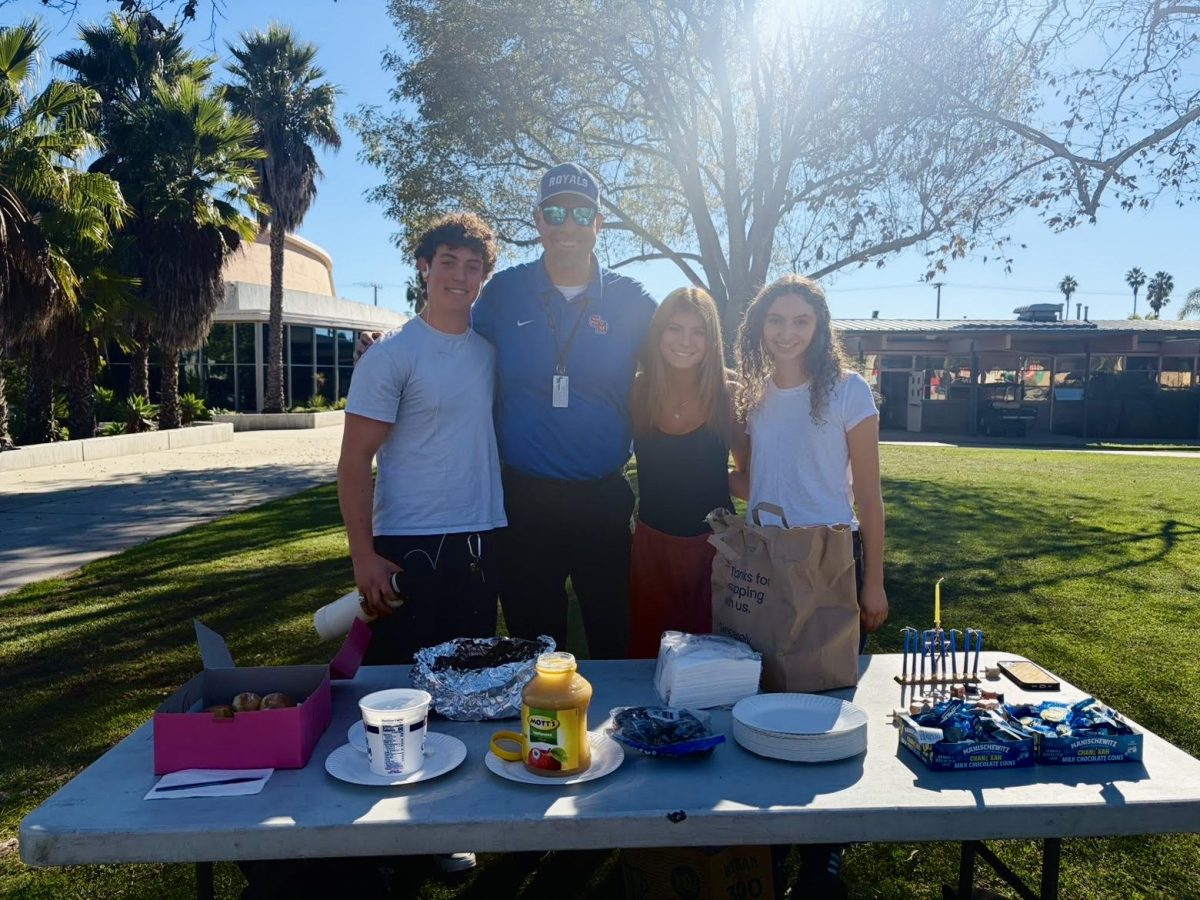
This year, our San Marcos Jewish Culture club held a Hanukkah celebration open to all students during lunch in the quad on Thursday, December 11th.
“We had a variety of traditional Hanukkah foods for people to try, including Latkes, donuts, and chocolate coins,” said Jewish club co-president Gemma Cooper, “Students also had the chance to try playing Dreidel and learn about Hanukkah traditions. All students were welcome to get involved and participate in Hanukkah celebrations!”
Hanukkah is a reminder that even the smallest amount of hope can illuminate difficult times. Make sure to join Jewish club you are interested in learning more about Hanukkah traditions!